Brand Image
12/5/2025

Why Your Grocery App Is a Tech Marvel: 5 Surprising Truths

#Grocery Apps#Tech Innovation
Why Your Grocery App Is a Tech Marvel: 5 Surprising Truths

Introduction: The Hidden World Behind Your Weekly Shop


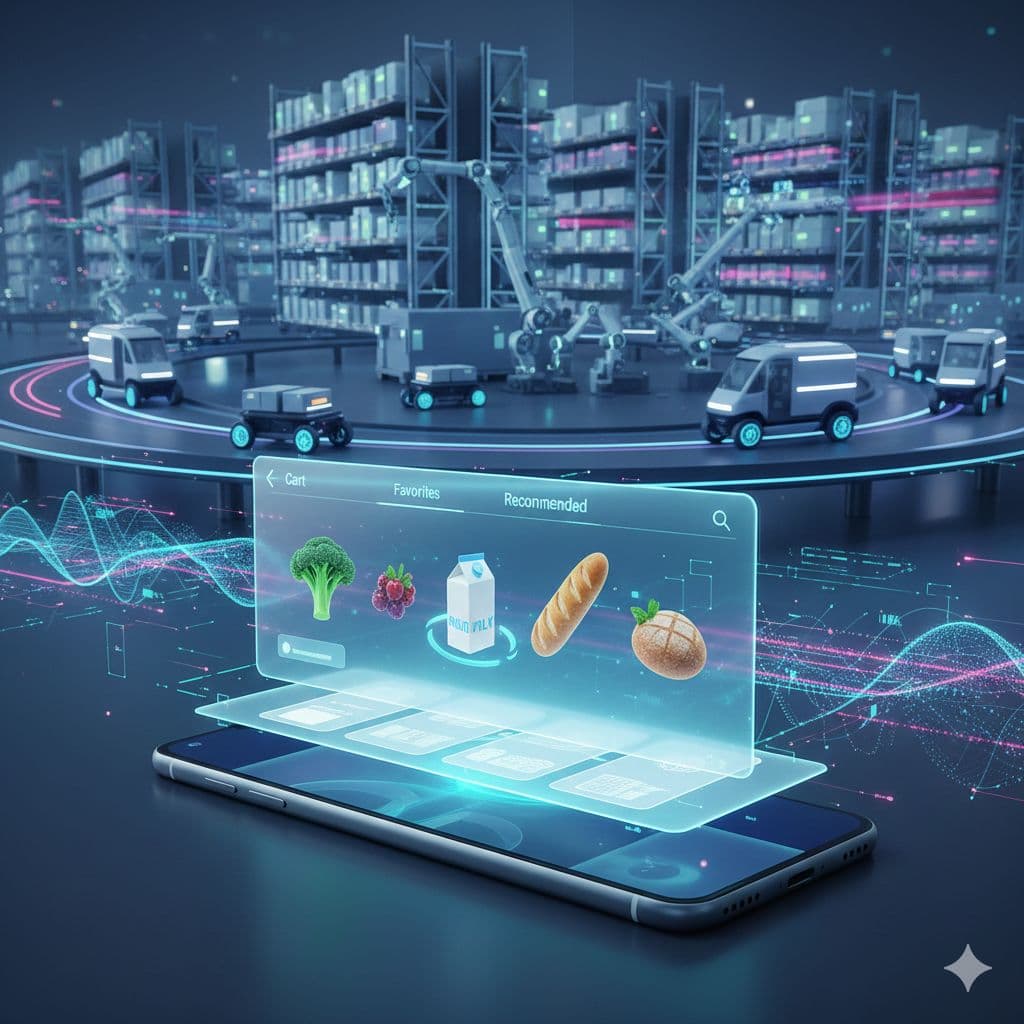
We’ve all been there: tapping a few buttons on a smartphone to order a week's worth of groceries or a last-minute dinner. The process feels seamless, almost trivial. You browse, you tap, you pay, and within an hour, a bag of perfectly ripe avocados or a hot pizza arrives at your door. The app on your screen seems like a simple digital storefront, a convenient menu brought to life.

But that simplicity is an illusion. Beneath that clean user interface lies a ruthless technological battleground. In the high-frequency, low-margin world of grocery delivery, the difference between a brand that thrives and one that disappears is measured in milliseconds, driven by code that anticipates your habits, and powered by logistics that would impress a military strategist. This isn't just e-commerce; it's a war for retention fought with data and engineering.

This article pulls back the curtain to reveal five of the most surprising technical and strategic truths that make modern grocery delivery possible. From the brutal economics of speed to the hidden complexity of selling a single chicken breast, you’ll discover that the app in your pocket is far more than a simple shopping cart—it's a marvel of modern technology.


1. Speed Isn't a Feature; It's a 300% Conversion Multiplier


In e-commerce, speed is money. Research shows a one-second delay in page load time can slash conversions by 7%. But for grocery apps, the penalty for slowness—the "latency tax"—is catastrophic. Unlike buying a single pair of shoes, a grocery order involves adding dozens of items to a basket. On a mobile website, each tap can trigger a round-trip to a server, creating micro-delays that accumulate into massive user frustration and abandoned carts.

This problem is magnified by the "impulse economy." Many orders are placed in "interstitial moments"—on a commute or between meetings—where cellular connectivity is unstable. A mobile website is fragile in these conditions; a dropped connection during checkout can kill the entire sale. A native app, however, is architecturally resilient. It stores its core UI components locally, making visual feedback instantaneous. More importantly, it uses an "optimistic UI," recording your actions to a local database and syncing with the server when a connection is restored. This ensures the impulse to buy is never lost to a network error.

This architectural superiority isn't just a "nice-to-have" feature; it's a financial game-changer that directly impacts the bottom line.

Native apps in the on-demand delivery sector can achieve conversion rates 307% higher than mobile websites.

For any scaling grocery brand, this performance gap makes a native app an operational imperative. In a market defined by impulse and speed, it is the fundamental engine for converting momentary intent into revenue.


2. Winning Grocery Apps Are Built for Habit, Not Discovery


Most e-commerce is built for discovery—helping you find a new product. The grocery business model is the exact opposite. It's predicated on frequency and habit: the same milk, eggs, and bread you buy week after week. The primary strategic goal is to move a customer from the open, competitive world of web search into the "walled garden" of an app, transforming them into a loyal, high-frequency user.

A native app is a "Retention Engine." Once installed, it’s optimized not for finding new things, but for effortlessly reordering old favorites. This is achieved through clever UI like a "Buy It Again" widget, which acts as a dynamic dashboard of the user's consumption habits. It leverages two powerful psychological shortcuts:

Visual Recognition: It displays images of past purchases, because users recognize product packaging far faster than they read text.

Predictive Ordering: It uses algorithms to anticipate needs. If you buy coffee every 14 days, on day 13 that coffee appears at the front of the list, making the app feel almost psychic.

The financial impact of this shift is profound. By engineering habit, brands see a dramatic increase in Customer Lifetime Value (LTV).

App users are the holy grail of retention, generating 3 to 5 times higher Lifetime Value compared to web-only shoppers.

This isn't an accident. The data shows app users purchase approximately 33% more frequently and exhibit higher Average Order Values (AOV). By removing friction, the app becomes the default choice, locking out competitors and securing market dominance.


3. The Most Powerful Marketing Messages Aren't Selling Anything


Push notifications give brands a direct, cost-effective marketing channel on a user's most personal device. But in the grocery vertical, the most effective notifications have nothing to do with sales or promotions. They are all about utility.

While a "20% Off" alert might work for a fashion brand, a grocery app wins by providing timely, helpful information that builds trust and simplifies the user's life. The best notifications are transactional, personal, and predictive.

Transactional: "Your driver is 5 minutes away."

Personalized Inventory: "The organic avocados you like are back in stock."

Predictive Utility: "You bought milk 7 days ago. Need a refill?"

What makes these alerts so powerful is the use of "Deep Linking," which takes the user from the notification directly to a pre-loaded cart or a specific product page. This reduces the path-to-purchase to a single, frictionless tap. This strategy of helpfulness over hype pays enormous dividends in the war for retention.

Users who opt-in to push notifications show retention rates 3x to 10x higher than those who opt-out.


4. The Surprising Complexity of Selling a Chicken Breast


Here is a problem that perfectly illustrates why generic e-commerce software fails in the grocery industry: selling fresh food by weight. Imagine you order "1 kg of Chicken Breast." The warehouse picker finds a pre-packaged tray, but it weighs 1.05 kg. This is the "Catch Weight" problem.

Most standard SaaS platforms are built to sell fixed units, not variable ones. They cannot handle the logic of charging a customer for a slightly different weight—and therefore a slightly different price—than what they originally put in their cart. This inability leads to one of two disastrous business outcomes: revenue leakage (by under-charging) or significant customer friction (by issuing constant, tiny refunds).

A custom-built grocery app solves this elegantly. During checkout, it places a pre-authorization on the customer's card for an estimated amount. Later, when the picker scans the item's actual weight, the system communicates with the payment gateway to capture the exact final amount. This single function is an absolute necessity for protecting the razor-thin margins of the grocery vertical and demonstrates why a one-size-fits-all solution is never the right fit.


5. Your "Smooth" Delivery Map Is a Deliberate Engineering Feat


We now expect a smooth, "Uber-style" map showing our driver's little car icon gliding seamlessly toward our location. This premium experience feels standard, but the technology is anything but. The jumpy, teleporting icon seen on many mobile websites is the result of an inferior approach called "polling," where the site repeatedly asks a server, "Where is the driver now?"

Top-tier native apps use a superior technology called WebSockets. This opens a persistent, two-way communication channel, allowing the server to "push" location updates to the app the instant they happen. But this is only half the magic. The app then uses native animation libraries to interpolate the movement of the icon between data points, creating the smooth, gliding effect we associate with a premium service.

Beyond a smooth map, native apps also leverage the phone's OS-level geofencing. This triggers automated, "magical" alerts like "Prepare for Arrival" when a driver crosses a virtual perimeter. This small feature has a huge operational impact, reducing driver wait times and customer anxiety. This experience isn't a vanity feature; it's a crucial engineering feat for building the trust and efficiency required to win the last mile.


Conclusion: More Than Just a Shopping Cart


The grocery and food delivery apps we use every day are not the simple digital storefronts they appear to be. They are highly sophisticated logistical and behavioral engines, meticulously engineered to reduce friction, build habits, and earn trust.

From the raw economics of speed that dictate architecture, to the deep psychology of habit that shapes the user experience, these platforms are triumphs of specialized technology. They solve unique, industry-specific problems—like the variable weight of fresh food—that generic software simply can't handle. Every element, from the predictive push notification that reminds you to buy milk to the smooth glide of a driver's icon, is a deliberate choice designed to make a complex operation feel effortless.

The next time you tap to reorder your weekly essentials, what other hidden layers of technology are you holding in the palm of your hand?